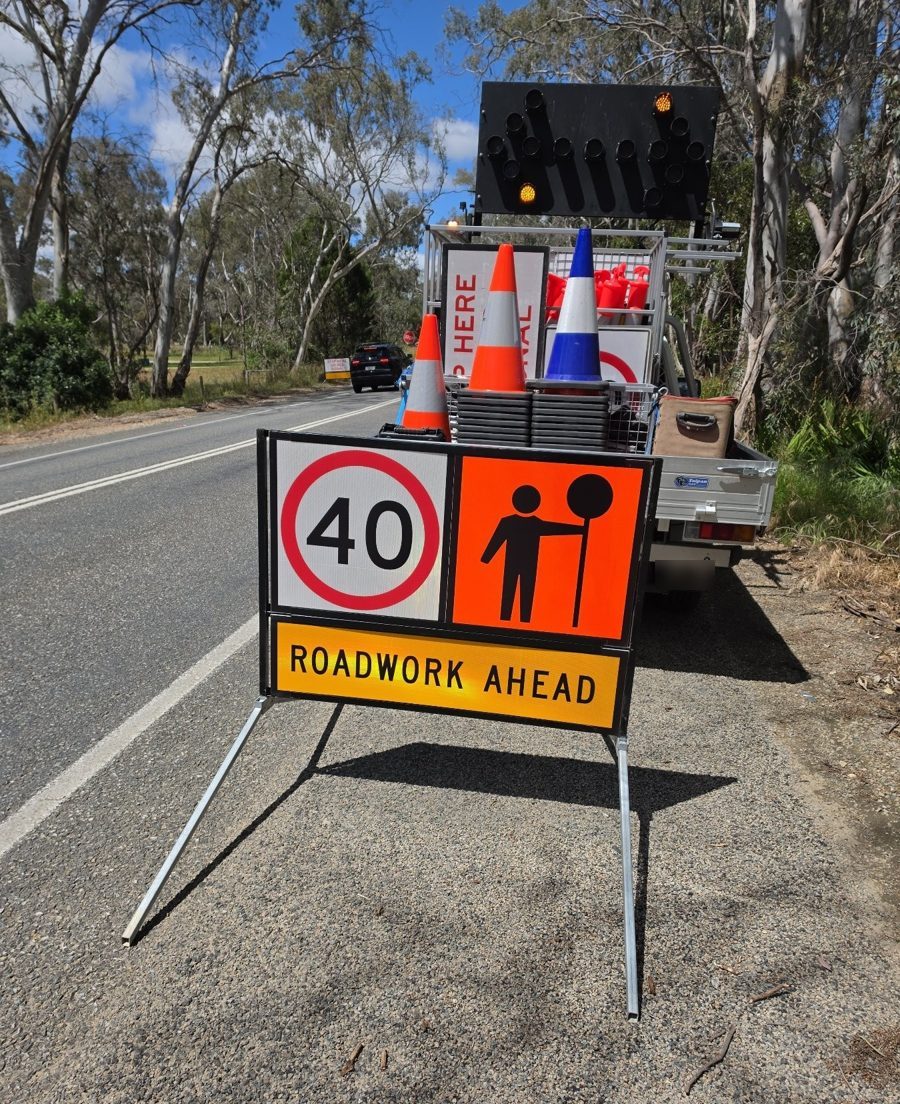
The two roadworks speed limits
Most roadwork zones in South Australia use one of two speed limits:
- 40 km/h in the immediate area of the work. This is the standard roadworks speed limit and the one drivers will see most often.
- 25 km/h where work is happening within 1.2 metres of the traffic lane. According to the RAA, this closer distance is where the risk to a road worker from a passing vehicle is highest, so the speed is dropped further.
On higher-speed roads, speed reductions are stepped down in increments, for example from 110 to 80 to 60 to 40 km/h, so drivers have time to slow safely. The advance warning signs can start 500 metres or more before the work area.
When the signs apply
If you see a reduced speed limit sign at a roadwork site and there are workers at the site, or the road is in a condition that creates a greater level of hazard than normal, the limit is law. That is true at any time of day, even at night, on weekends, and when no one is standing next to the sign. Newly laid road surfaces can take months to settle and develop proper skid resistance, so the signs often stay in place after the crew has left for the day.
When the signs do not apply
Under section 20 of the Road Traffic Act 1961, roadwork speed limit signs are of no effect if two things are both true at the same time:
- Workers are not engaged at the roadworks site, and
- the area of road affected by the works does not involve a greater than normal level of hazard for people using the road.
Both conditions have to be met. If the road surface is torn up, lanes are narrowed or barriers are in the way, the signs still apply even if no workers are there.
The Act also says workers are taken to be engaged at a site if they have been temporarily absent for two hours or less. So a crew that goes to lunch at noon is still considered to be at the site until at least 2pm.
Even when the temporary signs are not in force, the normal speed limit for that road still applies. Passing a roadwork sign at 80 km/h on a road that is normally posted at 60 km/h is still speeding.
Permanent signs must be covered
DIT's July 2026 workzone newsletter reminded the industry that permanent speed signs must be covered when a lower temporary limit is in place. Section 5.2.1 of the SA Standards for Workzone Traffic Management says any sign that conflicts with the temporary work zone situation must be covered, obliterated or removed. DIT permit condition 9.10 requires permanent speed signs to be covered for the duration of a speed reduction. If you pass a roadwork zone and see both a temporary 40 km/h sign and an uncovered permanent 60 km/h sign, the temporary sign is the one to follow.
The $1,250 fine for leaving signs out
Companies that leave temporary speed limit signs in place when they are not needed can be fined up to $1,250, according to the RAA. The Road Traffic (Roadworks) Amendment Act 2017 tightened the rules: anyone authorised to place roadwork signs must remove them when workers are not on site and the road is not hazardous. The aim is to stop drivers losing trust in roadwork signs because they see them left out on an empty stretch of road.
The 25 km/h breakdown vehicle rule
Since 19 May 2025, drivers in South Australia must slow to 25 km/h when passing a stationary breakdown service vehicle that is displaying flashing amber lights, with cones or bollards placed beside it by a breakdown worker. Breakdown service vehicles include tow trucks, vans and other vehicles providing roadside assistance.
The 25 km/h limit does not apply if the breakdown vehicle is on the opposite side of the road from you. It works the same way as the existing 25 km/h limit for passing emergency vehicles with flashing lights.
What we see on site
Our traffic controllers stand beside live traffic every day. The most common problem is not a disagreement about rules. It is speed. Drivers see the 40 sign and do 60 anyway, especially when they cannot see anyone working. The signs are there because the road is different from normal, and a crew, a plant operator or a changed surface could be just around the corner.
Good traffic management helps too. Signs placed early enough, a visible speed change, and a set-up that looks right for the road all give drivers confidence that the limit makes sense. That is part of our job. See our guide to traffic guidance schemes or our traffic control service.
Questions
What is the default speed limit at roadworks in South Australia?
The default speed limit through a work zone in South Australia is 40 km/h. It applies in the immediate area of the works, even if no workers are visible at that moment.
When does a 25 km/h roadworks speed limit apply?
A 25 km/h limit applies when work is happening within 1.2 metres of traffic. The signs will show 25 km/h. This is separate from the 25 km/h limit for passing breakdown vehicles with flashing amber lights.
Do roadworks speed signs still apply when no workers are there?
It depends. Under section 20 of the Road Traffic Act 1961, roadwork speed signs are of no effect if workers are not engaged at the site and the road does not involve a greater level of hazard than normal. But workers are taken to be engaged if they have been away for two hours or less, and hazards like fresh surfaces or narrowed lanes can keep the signs in force even after the crew has left.
Do I have to slow to 25 km/h for a breakdown vehicle?
Since 19 May 2025, drivers in SA must slow to 25 km/h when passing a stationary breakdown service vehicle displaying flashing amber lights with cones or bollards placed beside it. The limit does not apply if the vehicle is on the opposite side of the road.
Can a company be fined for leaving roadwork speed signs out?
Yes. According to the RAA, a company that leaves temporary speed limit signs in place when they are not needed can be fined up to $1,250.
Sources: Road Traffic Act 1961 (SA), section 20; Road Traffic (Roadworks) Amendment Act 2017 (SA); SA Standards for Workzone Traffic Management, version 8, section 5.2.1; DIT, Workzone Traffic Management newsletter, July 2026; DIT, Roadworks FAQs (dit.sa.gov.au); RAA, Speed limits around roadworks explained (samove.raa.com.au); RAA, Your roadwork questions answered; SA Law Handbook, Speeding (lawhandbook.sa.gov.au); DIT/Premier SA, Slow down for a breakdown, May 2025. Read 12 November 2026. Rules change; check current DIT guidance or ask us. More in news and guides.